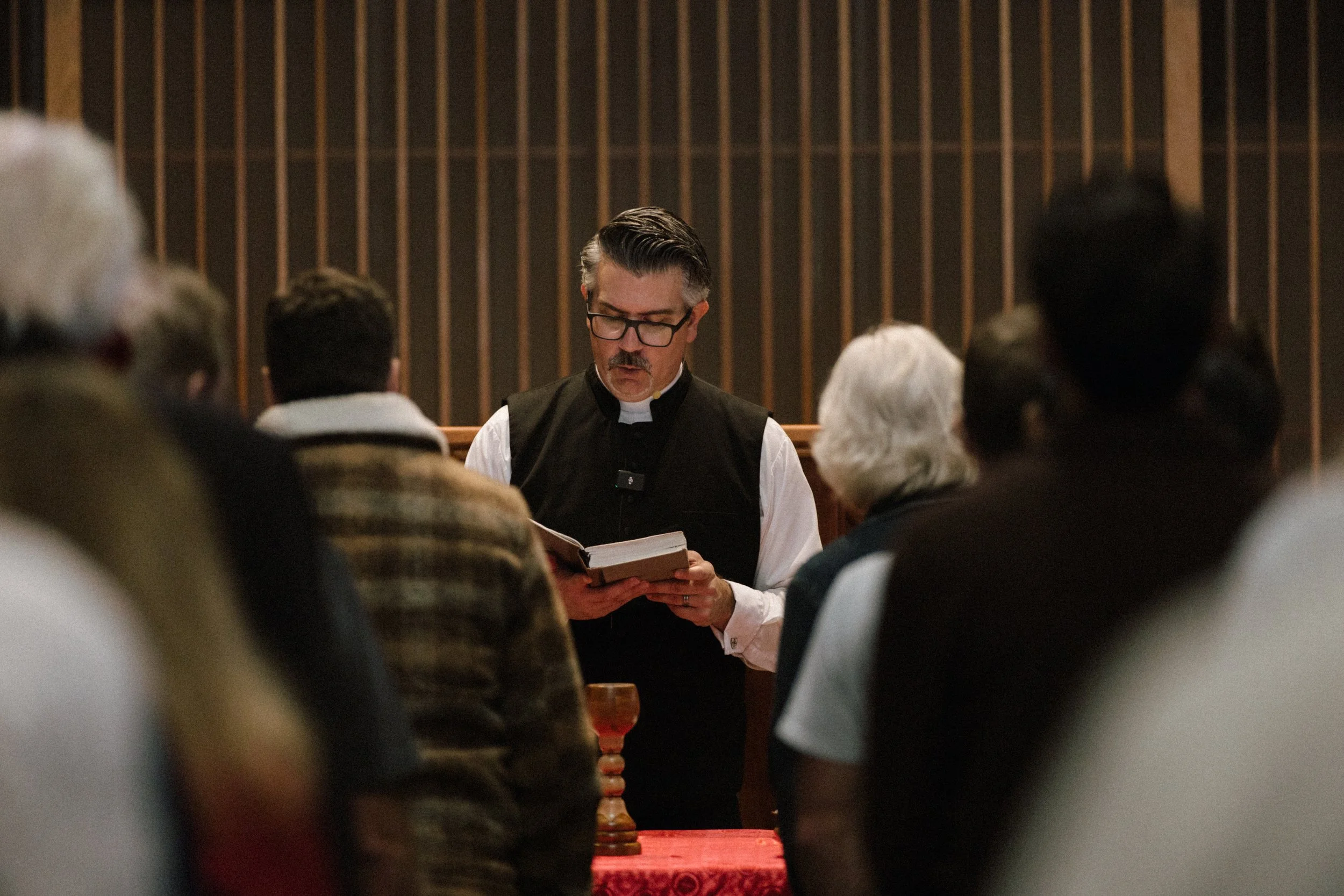
Why We Celebrate Weekly Communion
Daniel R. Hyde (c) 2026
Adopted by the Oceanside United Reformed Church Consistory, May 31, 2005
Introduction
As Christians, our only comfort is that we belong to our faithful Savior Jesus Christ (Heidelberg Catechism, Q&A 1), whom we experience in faith by the power of the Holy Spirit through the proclamation of the Holy Gospel and participation in the Holy Sacraments.
As pilgrims in this age, we need to hear, see, touch, smell, and taste this Gospel through the Word and Sacraments. These create and confirm our faith (Heidelberg Catechism, Q&A 65), lift up our hearts to our heavenly hope in the life of the world to come, and unite us in brotherly love. Thus, celebrating the Gospel in both the Word and Sacrament of the Lord’s Supper—as we assemble every week—is best for our spiritual health.
From the time we began worshipping together as a community in June of 2000, we incrementally increased the frequency of our participation as Christ’s body in his body and blood.
June 2000–October 2002: 7–9 times a year while a church plant of Escondido URC.
November 2002–July 2003: Monthly, after becoming a distinct congregation.
August 2003–November 2004: Twice a month.
December 2004–May 2005: Three times a month.
As of June 1, 2025, we moved to celebrating the Gospel in communion weekly for the following reasons.
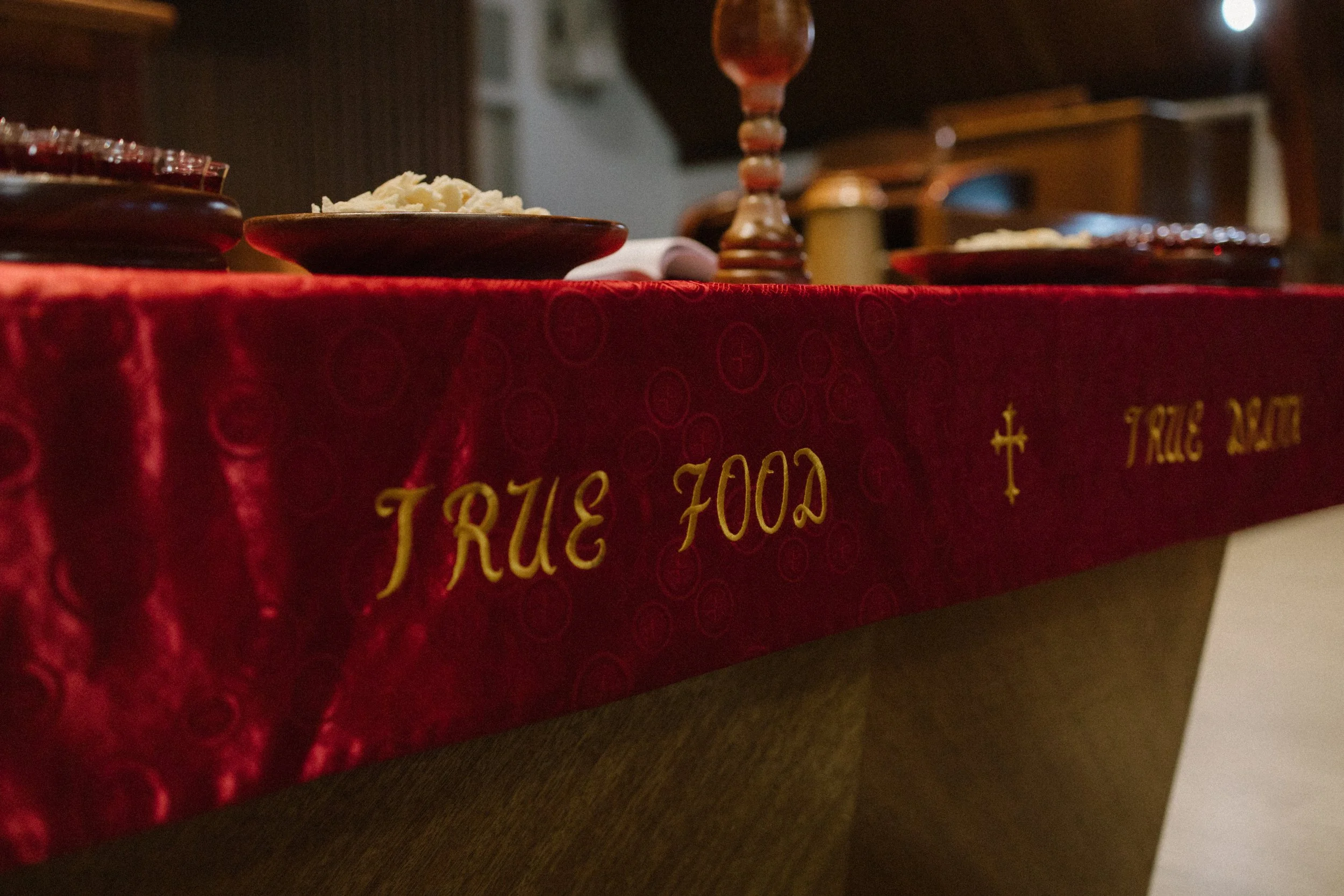
You have tasted the heavenly gift, and have shared in the Holy Spirit, and have tasted the goodness of the word of God and the powers of the age to come—Hebrews 6:4–5
New Testament Practice
The Lord’s Supper is an ordinary element of New Covenant worship.
Acts
Acts 2:42–49 describes the worship life of the early church by saying several things were done “continually.” This means that whenever they met, they participated in these elements. Acts 2:42 summarizes the basic elements of New Covenant worship:
And they devoted themselves to the apostles’ teaching and the fellowship, to the breaking of bread and the prayers.
These four basic elements of New Covenant worship were celebrated “daily” in the early days of the Church (Acts 2:46). This is why John Calvin argued for the Lord’s Supper “at least weekly” (Institutes of the Christian Religion, 4.17.43), and also said:
Thus we ought always to provide that no meeting of the Church is held without the word, prayer, the dispensation of the Supper, and alms. We may gather from Paul that this was the order observed by the Corinthians, and it is certain that this was the practice many ages after (Institutes, 4.17.44).
We know that the “breaking of bread” was the Lord’s Supper because St. Luke uses the definite article “the” before each of the four elements mentioned in Acts 2:42: the apostles’ doctrine, the fellowship, the breaking of the bread, and the prayers. This is a definite article par excellence, meaning, it is not just any bread. The Supper was called “the breaking of the bread” because that was what Jesus did on the Passover night (Matt. 26:26; Mark 14:22; Luke 22:19, 24:30; 1 Cor. 10:16, 11:24). The Lord’s Supper, then, was as ordinary as preaching, prayer, and fellowship. Calvin therefore concluded:
For there is not the least doubt that the Sacred Supper was in that era set before the believers every time they met together (Institutes, 4.17.46).
The New Testament also describes the worship of the Christian community as “coming together” for the express purpose of “breaking bread.” Acts 20:7 says: “Now on the first day of the week, when the disciples came together to [for the purpose of] break bread…”
Matthew Henry and John R. W. Stott both treated that as the “normal, regular practice of the church in Troas” (Stott, The Message of Acts, 321; Henry, Commentary on the Whole Bible, 2154). In that passage, the Supper is joined with preaching (Acts 20:7, 8, 11). Stott commented:
Word and sacrament were combined…and the universal church has followed suit ever since. For God speaks to his people through his Word both as it is read and expounded from Scripture and as it is dramatized in the two gospel sacraments, baptism and the Lord’s Supper...What builds up the church more than anything else is the ministry of God’s word as it comes to us through Scripture and Sacrament (that is the right coupling), audibly and visibly, in declaration and drama (Stott, The Message of Acts, 321).
1 Corinthians
Paul uses this same “coming together” terminology in 1 Corinthians (11:17, 18, 20, 33, 34, 14:23). He describes the church assembled as “coming together” for the purpose of preaching and partaking of the Supper (cf. Acts 20:7-11). This led Francis Turretin to write:
the practice of the apostolic church” was to “constantly retain[…] the breaking of the bread…which was customarily done on the Lord’s day when they assembled to hear the preaching and to perform the other public exercises of piety (Institutes, 3:445).
This “coming together” was as the “church” (1 Cor. 14:23). The Greek word ekklesia is the New Testament equivalent of the Hebrew qahal: a “covenant assembly.” What was the purpose of “coming together” as the covenant assembly? To “eat” the Lord’s Supper (11:33). Paul rebuked the Corinthians because they were not coming for that purpose but for their own purposes (11:17, 20). David Prior writes:
It is no wonder that Paul could not call the gatherings of the church at Corinth ‘the Lord’s Supper’: they were not under the Lord’s authority; there was hardly any awareness of the Lord’s presence; the purpose behind them seemed to be scarcely directed towards remembering the Lord’s death (The Message of 1 Corinthians, 187).
Hughes Oliphant Old concluded from these texts:
…it is in the meeting together for the purpose of sharing the meal that these individuals become the church…It is this supper which constitutes the church...The Lord’s Day is distinguished by the fact that it is the day for the celebration of the Lord’s Supper at the Lord’s Table, sharing all together the Lord’s Cup (Worship That Is Reformed According to Scripture, 110).
Summary of the New Testament Pattern
The life of the early Church was marked by participation in preaching and the Lord’s Supper—whether daily (Acts) or weekly (“on the first day of the week;” 1 Cor. 16:2) in Corinth.
Application: Heidelberg Catechism
This is explicitly taught in our Heidelberg Catechism Q&A 103 on the fourth commandment. We are to “diligently attend church to learn the Word of God, to use the Holy Sacraments, to call publicly upon the Lord, and to give Christian alms.” That corresponds to the four elements of Acts 2:42.
In his exposition of this commandment, Zacharias Ursinus (1534-83) said that besides preaching, prayer, and alms, we are “to use the Holy Sacraments,” and that, “…the use of the sacraments is most intimately connected with a proper observance and sanctification of the Sabbath” (Commentary on the Heidelberg Catechism, 568).
The Old Testament and Covenant Renewal
New Testament worship finds its background in the covenant renewals of the Old Testament. Every time we gather for worship, we renew our vows of trust in the Lord; more importantly, he renews his covenant of grace with us through the means of covenant signs and seals.
In other words, we participate in a covenant ceremony as did Adam, Noah, Abraham, Moses, Joshua, and the disciples in the Upper Room. Biblical covenants were ratified by signs in public ceremonies. That’s what we’re doing in worship.
With Adam: animal skins (Gen. 3:21)
With Noah: the rainbow (Gen. 9:13)
With Abraham: circumcision (Gen. 17:10)
With Moses: the blood of the covenant (Ex. 24:8)
With Joshua: circumcision of the second generation (Josh. 5:2)
With the disciples and with us: the Lord’s Supper—“the new covenant” (Luke 22:20) in visible form.
When a covenant is renewed in Scripture, a communal meal is celebrated in the presence of God (e.g. Neh. 8:9–12, 18; Ex. 24:11; Deut. 12:6–7, 14:26; John 6:53–58; 1 Cor. 5:7–8, 11:25–26; Rev. 3:20, 19:9). That’s what the Lord’s Supper is for us in the New Covenant.
The Holy Supper and our Struggle with Sin
We need the Lord’s Supper because of our wretchedness. Our confession says:
We believe that our gracious God, mindful of our insensitivity and weakness, has ordained sacraments (Belgic Confession, article 33).
The sacraments are the gifts of God for the people of God, which we need to take advantage of as much as we are able in “this present evil age” (Gal 1:4).
As those who are “insensitive” and obstinate in heart and will, our Father has given us bread and wine to fill us with his grace and move us to gratitude. They are also an accommodation to us, as our Father is “mindful” of our sin; “he knows our frame, he remembers that we are dust” (Ps. 103:14).
God has given Christ’s body and blood in visible form to those who cry, “Lord I believe; help my unbelief” (Mark 9:24), and, “increase our faith” (Luke 17:5). This is why our Confession says God gave the sacraments “to nourish and sustain our faith” (Belgic Confession, article 33) while the Catechism says they are the means by which the Holy Spirit “confirms” our faith (Heidelberg Catechism, Q&A 65).
God’s Works Among Us
God works through the elements of voices, water, bread, and wine. Notice how our Confession speaks of the Supper, in terms of the personal pronouns used:
God…has ordained sacraments to seal His promises…to be pledges of His good will and grace…He did so to nourish and sustain our faith. He has added these to the Word…to represent better…what He declares…and what He does inwardly in our hearts. Thus He confirms to us the salvation which He imparts to us. Sacraments are visible signs and seals of something internal and invisible, by means of which God works in us through the power of the Holy Spirit… (Belgic Confession, article 33)
Because we are Reformed, we believe the Lord’s Supper is not chiefly a matter of our working, receiving, or preparing, but of God’s work in us through these means. Most specifically, the Supper is the instrument of the Holy Spirit: “By means of which God works in us through the power of the Holy Spirit.”
Along with preaching, the primary way the Spirit sanctifies us to be holy is through these means. He fills us with himself and all his goodness that we might truly be “temples of the Holy Spirit” (1 Cor. 3:16). The Holy Spirit is among us not in tongues or exciting music, but in his Word and Sacraments.
The Clearest Proclamation of the Gospel
The sacraments are the clearest way the promises of God are given to us. As the Belgic Confession says,
He has added these to the Word of the gospel to represent better to our external senses both what He declares to us in His Word and what He does inwardly in our hearts” (art. 33).
Calvin wrote:
The sacraments bring the clearest promises; and they have this characteristic over and above the word because they represent them for us as painted in a picture from life. (Institutes, 4.14.5)
…in the Supper we have more ample certainty, and fuller enjoyment of it (Short Treatise on the Holy Supper, 10).
Theodore Beza, described this sensory strengthening of faith by the sacraments:
The Word…strikes only one of our five natural senses, but the Sacraments touch more the sight and other bodily senses…In a manner of speaking, they enable us to touch with our fingers and see with our eyes, and as to taste and feel Jesus Christ in Person, as if we already had and held Him (The Christian Faith, 55).
We can also say the sacraments—especially the Lord’s Supper—proclaim the Gospel clearly because they do so dramatically. Our services are too often considered dull, boring, and overly “teachy” because we have neglected drama: God’s drama of the Holy Supper.
This is why the Supper is to be festive, not overly-didactic, joyful, not somber, celebratory, not a drudgery—especially in a day when many evangelical Christians are joining Rome and the Eastern Orthodox Church because of their multi-sensory worship. We Protestants tend to present Christianity either through an overly rational presentation or via entertainment-based worship, neither of which sufficiently quenches the spiritual thirst of most postmodern people.
Because the Supper is to be enjoyed and celebrated, it is to be done so with a sense of holy mystery. As Calvin said in answer to the question of how believers partake of Christ:
…I shall not be ashamed to confess that it is a secret too lofty for either my mind to comprehend or my words to declare…to speak more plainly, I rather experience than understand it (Institutes, 4.17.32).
How do we ascend to heaven to partake of Christ? By faith through the working of the Holy Spirit, who uses the Word and Sacraments. Calvin wrote on Psalm 132:7:
…the Holy Spirit condescends for our profit, and in accommodation to our infirmity, raising our thought to heavenly and divine things by these worldly elements” (Commentary on the Psalms, 5:150).

My soul will be satisfied as with fat and rich food, and my mouth will praise you with joyful lips.—Psalm 63:5
History of the Church’s Practice
Ancient Church
Weekly communion follows the pattern of the most ancient churches. The Didache (written between 60–80 AD), includes instructions for communion, which was done weekly:
On the Lord’s own day gather together and break bread and give thanks, having first confessed your sins so that your sacrifice may be pure (ch. 14).
Justin Martyr wrote his First Apology around 150 AD. He described routine Lord’s Day worship in second century Palestine with the following elements (ch. 67):
Scripture Lessons
Sermon
Prayer
Presentation of the Bread and Wine
Prayer
Distribution of the Bread and Wine
Offering
In the late fourth century, Augustine spoke of the diversity and frequency of communion in his First Epistle to Januarius:
Some communicate daily in the body and blood of the Lord; others receive it on certain days…in others, it is offered only on the Sabbath and the Lord’s day: in others, on the Lord’s day only. But since…the people were sometimes remiss, holy men urged them with severe rebukes, that they might not seem to connive at their sluggishness.
Jerome testified that in Rome and Spain the church celebrated the eucharist daily (Letter 71).
One of Augustine’s disciples, Gennadius Scholasticus (d. 496), spoke of the frequency of Holy Communion:
Every day…I neither praise nor blame to receive the communion of the Eucharist, however, I recommend and urge to communicate every Lord’s day.
Medieval Church
But sometime during the Medieval period, the innovation of less-than-weekly communion became normal. The Medieval Roman Church developed the non-Eucharist, preaching-only service. Because of superstition, Communion was eventually offered to the congregation only once a year. Calvin called this practice “an invention of the devil” (Institutes, 4.17.46). Infrequent communion, then, was an innovation in historic church practice, not the practice of frequent communion. It is not “Roman Catholic” to have the Supper weekly but Christian and Reformed.
Reformation
Weekly communion was a reform that was left for us to institute where able.
John Calvin
Calvin said this at the end of his life:
I have taken care to record publicly that our custom is defective, so that those who come after me may be able to correct it more freely and easily.
Without the obstacles of the Genevan city council for Calvin or the obstacle of not having enough ministers for Knox in Scotland or the Reformed in the Netherlands, weekly communion would most likely not even be a debate today.
Calvin also taught that people must learn:
the necessity of their frequent participation in the flesh and blood of the Lord as well as to its great benefits, which are received from this participation and mastication (Calvin’s Ecclesiastical Advice, 165).
In opposition to Papist infrequency, he wrote
…the Lord’s Table should have been spread at least once a week for the assembly of Christians, and the promises declared in it should feed us spiritually (Institutes, 4.17.46).
Puritans
There is a lengthy history in the Reformed tradition advocating frequent Communion. The Puritan Thomas Goodwin argued that the Supper is a continual ordinance—like preaching and prayer—so that minimal requirements appear to be weekly rather than arbitrary (Works, 11:388–409). As Goodwin noted: if other continual ordinances are expected on the Lord’s Day and are characterize distinctly Christian worship, why is the Supper arbitrarily excluded from what is to transpire when the church gathers?
Holy Communion and the Needy
The Supper has always been an occasion for diaconal offerings throughout the history of the Church. Communion moves us to care for the poor and needy as the one body of Christ. The benevolence offering after the Supper has been the means to give deacons tangible ways of caring for the poor inside and outside the church. As we see the one bread broken, we are reminded that we must pool our resources to care for each other in times of need.
Holy Communion and Love
The Supper is also a means by which we grow together as the one body of Christ. As the Confession says:
In short, we are moved by the use of this holy sacrament to a fervent love of God and our neighbors (Belgic Confession, article 35).
As a joyful celebration, we see each other come forward to receive the elements, we partake together, and we depart the refreshed in grace and renewed in our love for each other.
Conclusion
Celebrating Communion every Lord’s Day is biblically, historically, and theologically sound—and of immense practical benefit to us. In Communion, the Holy Spirit feeds us with Christ, applying him to our souls in grace and in power.
At this Table, we hear the gracious words of Jesus to our souls:
As certainly as this bread is broken before you, and this cup is given to you, and with your mouth you eat and drink in remembrance of Me, so surely do I nourish and refresh for everlasting life your hungry and thirsty souls with My crucified body and shed blood (Celebration of the Lord’s Supper – Form 1).
May we come to the Table with a hunger and thirst for righteousness. In doing so, the Lord will satisfy our hearts.
Taste and see that the Lord is good (Ps. 34:8).
Note: See also fellow United Reformed Churches in North America minister, Michael S. Horton, “At Least Weekly: The Reformed Doctrine of the Lord’s Supper and of its Frequent Celebration.” Mid-America Journal of Theology 11 (2000): 147–69.